At the center of the best-preserved area of the Venice Laguna, rich in biodiversity and farming and fishing activities, the Lazzaretto Nuovo is a field outpost for the local area’s scientific institutions, schools and other groups. The Path of the Barene displays the ecomuseum’s naturalistic side, serving as a frame and platform to collect and promote dialogue and the development of the various dedicated initiatives.
The breath of the Venetian lagoon, from sunrise to sunset: tidal rhythms in a ghebo among the salt marshes.
The Lazzaretto Nuovo is a museum surrounded by greenery: inside the walls, museum exhibits and an open-air archeological itinerary are located in the large garden, crowned by rows of two hundred year old mulberry trees flanking the radial paths in the Austrian style. Other small clumps of trees (ash, poplar, blackthorn) bear witness to the wooded nature of the laguna’s island habitats before human colonization.
The perimeter of the island sinks gradually into the original laguna, represented by the barene (from the Venetian dialect: “baro”: bush/fallow). They are the most unusual habitat of the lagunar ecosystem and serve as an important litmus test of the relationship between man and nature: taking this extraordinary singularity as its point of departure, the Path of the Bareneis the ecomuseum’s nature walk.
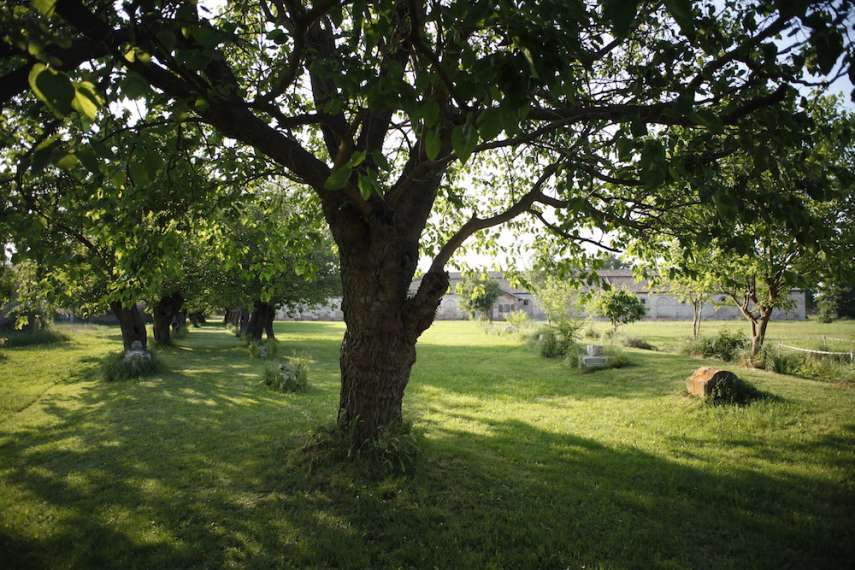
The inner garden and the rows of centuries-old mulberry trees.
The island promotes familiarity with an ecosystem whose protection is more than ever crucial, against the progressive destruction and transformation of the environment and the social and productive fabric it supports: over the past century, 70% of the original barene have disappeared, and the average depth of the waters has tripled, with powerful ecological, and also economic effects, as well as impacting on the inhabitants’ emotions and sense of identity.
The approach taken by Lazzaretti Veneziani follows an action plan that is sustainable for people, the planet and the furthering of the goals of Agenda 2030 and the innovative role of “heritage communities”, participatory and linked to the “genius loci”, as promoted by the Faro Convention of the Council of Europe.
Since 2000, Eco Day has been a participatory event that each year promotes interest in and protection of the laguna environment. Volunteers are directly involved in the cleaning of the Lazzaretto Nuovo’s shoreline and the banks of the surrounding waterways, as well as those of other islands, picking up cubic meters of detritus from our consumer society, coughed up by the high tides in winter.
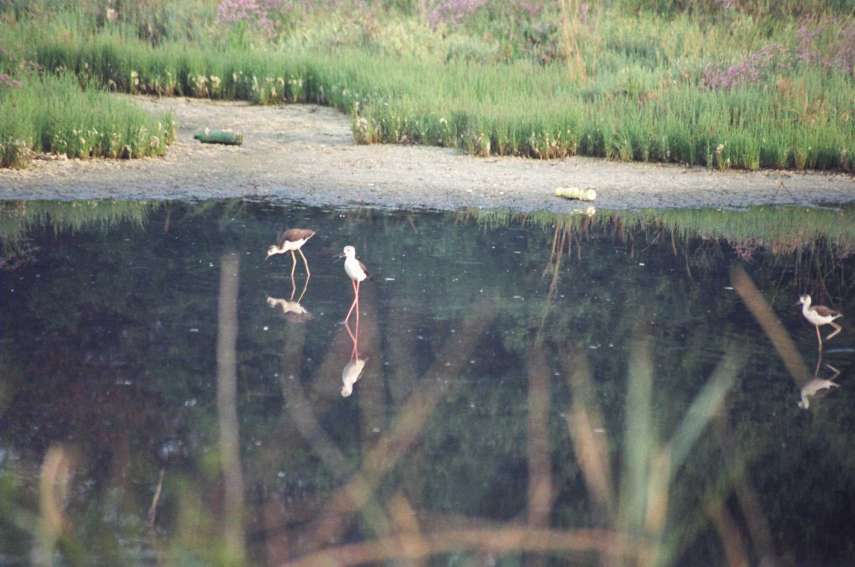
Black-winged stilts on the saltmarshes surounding the Lazzaretto Nuovo. Wetlands are environments that play a fundamental role: they host the greatest biodiversity on Earth and are key hubs along migratory routes. But they are also ecosystems that are particularly sensitive to the impacts of climate change
Lively chatter among black-winged stilts as they arrive on the island in late March, after their long transcontinental journey.